I’m dead chuffed to announce that my first piece of creative non-fiction has been published. You can read it in full on the Ellipsis Zine site here Third Best Fighter in the Year.
This is a departure for me from working on fiction to creating a novel length memoir that focuses on working class masculinity and ADHD.through me and my father’s lives.
A mate, said, ‘Who’d want to read a memoir about you. You’re not famous.’ This is true and it’s the question I most often ask myself when writing a piece of creative non-fiction: why am I writing this? Who will want to read this? But good creative non-fiction isn’t just about the narrator, or subject, as in the person at the centre of it, it’s about the themes they touch on, the connections they make and their voice.
Creative non-fiction uses the same literary styles, tools, and storytelling techniques of fiction applied to real events to create a compelling narrative.
The piece in Ellipsis Zine is short, just under a 1000 words, but gives a flavour of what I’m aiming for, so if you do read it, let me know what you think.
I’m currently writing a memoir centred around my dad and me, looking at working-class masculinity with a bit of ADHD thrown in for good measure, and it led me to remember an incident at school that turned the notion of the weaker sex on its head. If you want to find out more about this, you’ll have to keep an eye out for the August edition of Ellipsis Zine. This is the second piece of creative non-fiction I’ve had accepted for publication and could possibly be the first that you, wonderful reader, will get to see.
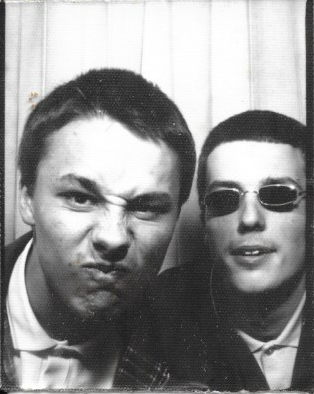
This image of me, I’m the one on the left, is from around the time the story is set, probably slightly earlier. Looking at my hair, I’d say I’m at the tail end of my Suedehead stage and moving into full-on Mod mode. I’m wearing a Fred Perry t-shirt and my coveted red Harrington jacket.
The guy next to me is called Rupert, which is about the best name, short of Tarquin, to guarantee getting your head kicked in at Mereway Upper School. I can’t remember how we became friends, probably a shared taste in music and clothes, but he was the first middle-class kid I ever met and became a conduit to a world I’d only seen on TV.
Like me, he lived close to the school, but unlike me, he lived in a large semi-detached house with a huge garden and a short drive out the front, which made our two-bed council house seem positively hutch-like by comparison. He never spoke about his dad. His dad was not present, but his effervescent mother and eccentric grandmother made me feel incredibly welcome. I think his mum was slightly concerned about him hanging out with the rough kid from the council estate, but his gran spoke to me like an equal and regaled me with tales of India and the Far East.
I never really knew how he felt about me because we don’t speak about stuff like that. He often seemed aloof, acting superior when it came to matters of music and clothes, but would defer to me when we were threatened by others; he wasn’t a wimp. Fighting was best avoided as it could lead to a torn shirt or scuffed shoes. Maybe he used me as muscle, I don’t know, but I know I got as much from him as he got from me with regards to tips on music and clothing, and I think that’s pretty good for any relationship.
I thought he was the best drummer in the world, although, to be more accurate, he was the only drummer in the world that I knew. He would calmly tolerate my discordant chord-chopping on my shit guitar and drum along perfectly to the first Specials album.
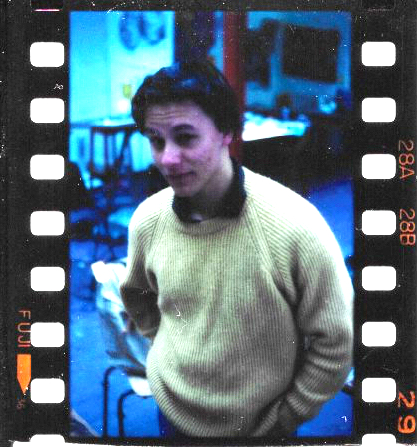
Me at art college, Bradford 89-91.
I bumped into him once in The Racehorse pub in Northampton. It was the mid-nineties, and I’d not seen him since school. I’d been away to Bradford studying Art and found myself unemployable and back home. We hadn’t spoken for 6 or 7 years. I’d embraced Acid House and Baggy culture, and my days of short hair and Harringtons were long behind me. It was early afternoon, and I’d already had a couple.
‘Betsy!’ No one used his first name.
‘Betsy!’ No one used his first name.
He flinched, as if bracing for an assault.
‘Fucking Hell, man. How are you doing? Let me get you a pint. Lager?’ Two beers into the afternoon, and I
He nodded.
‘Sit down. Sit down. I won’t be a minute.’
I placed a pint of lager and a pint of bitter on the table.
‘What are you up to these days?’
Again, that look, like I was the Stasi checking his papers at a Berlin checkpoint. I ploughed on. Asked him questions and never once thought the silence was oppressive. Eventually, three beers in, I learned that he’d sold his drum kit and now worked as a panel beater in some small industrial unit off the Welly Road.
‘You sold the drums?’
‘Yes.’
‘You sold the drums?’
‘We’ve covered this.’
As weird as his working as a panel beater was, it was the selling of the drums that floored me. Effectively, we’d swapped roles. I was working in a care home, a stopgap to build up funds and go travelling, but painfully aware I didn’t belong there, while my former mentor in music and clothes was wearing shitty overalls and hammering metal all day instead of doing the thing I’d thought he was born to do.
Rupert will feature in future writing, but to learn more about the world I grew up in, you’ll need to wait for the August edition of Ellipsis Zine.
Birmingham writer, Kit de Waal, has set up a scholarship for marginalised people. She wants to give someone, who wouldn’t otherwise have it, the opportunity to write and to develop as a writer.
Kit says, ‘I really see a gap in white, working-class stories – it’s a massively neglected area. I don’t think the experience of the white working class is valued enough.’ I couldn’t agree more.
She also talks about some of the reasons for the lack of working class literature, ‘I think there are gatekeeping processes at work in publishing. First, you need an agent, and you need the time to write. That’s one way you’re going to be filtered out of the system. Maybe there is a lack of confidence in our working-class stories, in whether people want to hear them? But sometimes we have to tell them, otherwise other people do so on your behalf, and that’s no good. We have a responsibility to tell our stories, and the industry has a responsibility to hear them.’
Working class stories are really important to me. My father was a builder, a labourer and tells some incredible stories of friendship, betrayal, law breaking, violence and toe curling humour. These stories are not represented in publishing. These are the stories I write and the stories I want to read.
I think this is the reason I enjoy Sleaford Mods. They tell modern day working class stories with none of the romanticised crap that you see in shows like Call The Midwife and the like.
Please read the whole of the article on Kit and her scholarship here and if you are a working class writer apply.
How about a list of great working class books or stories?
Do you work in the Arts? If you do it’s likely that you come from a middle-class background or if you don’t you’re most likely part of a dying breed.
Yesterday, The Guardian, reported on a survey looking at diversity in the Arts run by Create in collaboration with Goldsmiths University.
“A whole host of studies have demonstrated clear evidence of inequalities in cultural jobs based on people’s gender, ethnicity and class,” says Dave O’Brien of Goldsmiths, who is heading up the research. “However, there has yet to be a comprehensive picture from across different occupations. There’s a need for much more comprehensive data about working life in the cultural and creative industries.” Goldsmiths recently found that only 18% of Britain’s cultural workforce were born to parents with working-class jobs.
A previous study revealed significant obstacles for working-class actors. “People from working-class backgrounds were underrepresented compared to those from more affluent backgrounds,” O’Brien says. “Access to drama schools, the ability to get a top agent, and the ability to live in London and do the multiple, often unpaid, jobs that allow access to acting were clearly related to an actor’s social background.”
The results will be out in November and no prizes for guessing what they’ll turn up. However, to give them a clear picture as possibly why not click on this link and take part in the survey? It only takes a couple of minutes. Click here.